
Let the camera drop just a few centimeters in a scene, and even the sturdiest hero suddenly looks fragile. Let it tilt a few degrees to the side, and it makes you feel, without a single line of dialogue being written, that the world has come off its axis. In cinema, narrative already begins to take shape long before any line is written, through the decision of where the camera is placed and how it moves. In this article, let's examine one by one, with examples, how camera angles and camera movements actually work — which technique works in which scene, and why.
Camera Movement or Camera Angle? Let's Clarify This Distinction First
In everyday language, the two are frequently used interchangeably, yet they answer different questions. Camera angle describes at what height and direction the camera sits from a fixed point relative to the subject: is it low, is it high, is it level, is it tilted? Camera movement, on the other hand, describes how this position changes over time: is it sliding, is it turning, is it approaching? In a shot, the camera can move while starting from a certain angle and either maintaining or changing that angle; the two usually work intertwined. Talking about shooting techniques without clarifying this distinction is like constructing sentences without knowing grammar — it works, but it stands shaky.
Camera Movements: The Invisible Choreography of the Narrative
Choosing a camera movement means giving the scene a tempo. When the camera stands still, the viewer watches the scene from the outside; the moment the camera starts to move, the viewer is pulled into the scene. Distance, closeness, chaos, or calm — all of these change depending on how the camera moves at that moment. In this section, let's go through, one by one, from the moment it stands still to the most complex tracking shots, which feeling each movement triggers in the viewer and why it's chosen in which scene.
Static Shot (Fixed Shot): Leaving the Scene to the Actors
The camera stands completely still on a tripod; the job of moving is taken up by the actors and the elements in the scene. It's preferred in dialogue-heavy scenes, in moments when facial expressions need to be watched without distraction, and when actors are meant to be given room for improvisation. Because when the camera doesn't draw attention to itself, the scene is left to the actors.
Pan: Opening the Scene Sideways
This is when the camera stays at a fixed point and turns right or left on the horizontal axis. It's generally used to reveal information, introduce a wide space, or follow a moving subject. Its sped-up version is called a whip pan; it allows for showing the passage of time, distance, or creating an energetic connection between two characters without cutting.
Tilt: Power and Fragility on the Vertical Axis
This is when the camera again stays at a fixed point and turns up or down on the vertical axis. An upward tilt generally conveys grandeur, power, or longing, while a downward tilt conveys fragility, oppression, or a shift in power. A classic example of this is used when the camera tilts upward to show a character dwarfed in front of a massive structure or creature.
Dolly: The Camera's Physical Walk
This is when the camera physically moves toward or away from the subject on rails or a wheeled mount. Dollying in increases tension or closeness; dollying out emphasizes isolation, disconnection, or an expansion of context. Truck, on the other hand, is a different movement: the camera slides sideways parallel to the subject, moving side to side rather than forward and backward. In Turkish sources, these two are occasionally confused with each other. The international standard distinction is clear; Dolly = forward/backward, Truck = sideways.
Truck: Walking Side by Side with the Scene
This is when the camera stays at a parallel distance to the subject and shifts right or left; it's the exact perpendicular counterpart to Dolly's forward/backward axis. As a character walks, runs, or a vehicle travels, it keeps the camera beside them — it doesn't move closer to or farther from the subject, it only slides sideways along with them. That's why it's preferred when an action needs to be followed without interruption, or when a space needs to be swept sideways in a single breath.
Pedestal: Rising Without Breaking the Angle
This is when the camera body rises or lowers on the vertical axis without its angle changing. The difference from Tilt is that it's not just the viewpoint but the camera itself that changes position; it's ideal for following a tall subject without breaking the frame.
Zoom: The Artificial Form of Getting Closer
Technically, it isn't even counted as a camera movement. The camera stays in place; only the lens's focal length changes. Because it has no natural equivalent in the human eye, it feels somewhat artificial, even unsettling — which is why it's frequently chosen in the horror and thriller genres.
Dolly Zoom (Vertigo Effect): The Moment Reality Fractures
This is Dolly and Zoom applied simultaneously in opposite directions: as the camera moves toward the subject, the lens zooms out (or the exact opposite). As a result, while the subject's size stays fixed in the frame, the background stretches or compresses in an unreal way. It's one of the most powerful ways to visually convey dizziness, sudden trauma, or a fracture in the perception of reality.
Roll: Tipping the World Sideways
This is when the camera rotates around its own optical axis; the horizon line tilts within the frame. It's rarely used because its effect is very pronounced. It's reserved for moments of drunkenness, crisis, or a distortion of reality.
Tracking Shot (Follow Shot): Bringing the Viewer Into the Scene
This is when the camera physically moves together with the subject for an extended period; it brings the viewer into the physical world of the scene.
Arc Shot (Orbit Shot): Placing the Subject at the Center
This is when the camera traces a full or half circle around the subject; it places the subject at the center of the narrative, and is generally used in moments of inner confrontation or a shift in the balance of power.
Crane Shot: The Signature of a Grand Entrance
This is when the camera moves up, down, or sideways in wide arcs with the help of a mechanical arm. This arm itself is technically called a Jib. Crane, on the other hand, is the name for the entire system that encompasses the Jib, its fixed (usually wheeled) base, and the counterweights. In other words, every Crane Shot contains a jib, but not every jib shot requires a large crane setup. On set, this distinction often loosens. Crews use the two interchangeably regardless of scale. It's preferred for grand establishing shots and moments where a sense of scale is meant to be created.
Handheld Shot: From Raw Energy to Fluid Elegance
This is when the camera is carried directly by hand or on the shoulder without any stabilizer. The natural shaking adds a documentary feel, raw energy, and a sense of reality to the scene. It's effective in moments of chaos or for reflecting a character's subjective viewpoint. The shakiness here isn't a flaw — it's a deliberate narrative choice.
Steadicam / Gimbal: The Camera Gliding Through the Air
In scenes that call for the exact opposite of shakiness, a different tool comes into play: even as the operator walks, runs, or even climbs stairs, this shake never transfers to the camera at all — the image stays fluid and uninterrupted. Steadicam achieves this entirely through mechanical means; a vest worn by the operator, a spring-loaded arm, and a "sled" carrying the camera are all connected to one another; no motor or battery is needed, balance is provided by physics and the operator's years of accumulated skill.
Gimbal, on the other hand, is the modern, motorized counterpart to this: small motors and sensors balance the camera in real time across three axes; it's far more compact, cheaper, and easier to learn. While the shakiness of a Handheld camera is a deliberate choice, Steadicam and gimbal pursue exactly the opposite goal: eliminating that shake entirely and rendering the camera nearly invisible. One adds the flaw to the scene, the other removes it. Both are correct — they're simply the answer to different scenes.
| GROUP | MOVEMENT | HOW THE CAMERA MOVES | KEY NARRATIVE EFFECT |
|---|---|---|---|
| Reference Point | Static Shot | Remains completely fixed on a tripod, no movement at all | Leaves focus to the actors, natural/observational feel |
| Axis Movements | Pan | Rotates horizontally from a fixed point |
Revealing information, following |
| Axis Movements | Tilt | Rotates vertically from a fixed point |
Up: power/grandeur · Down: fragility |
| Axis Movements | Roll | Rotates around its optical axis | Instability, sense of dizziness |
| Position-Changing Movements | Dolly | Moves toward / away from the subject |
In: intimacy/tension · Out: isolation |
| Position-Changing Movements | Truck | Slides laterally, parallel to the subject | Scanning the action, following |
| Position-Changing Movements | Pedestal | Angle stays fixed, camera body shifts vertically | Capturing scale without breaking the frame |
| Position-Changing Movements | Tracking Shot | Moves alongside the subject for an extended time | Physical immersion in the scene |
| Position-Changing Movements | Arc Shot | Circles around the subject | Dramatic emphasis, inner confrontation |
| Position-Changing Movements | Crane Shot | Sweeps in a wide arc via a mechanical arm | Grandeur, scale, sense of establishment |
| Optical / Hybrid Movements | Zoom | Camera stays fixed, focal length changes | Artificial intensification, unease |
| Optical / Hybrid Movements | Dolly Zoom | Dolly and zoom applied simultaneously in opposite directions | Dizziness, trauma, a moment of rupture |
| Stabilization Techniques | Handheld Shot | Carried by hand, with no stabilizer | Raw realism, chaos |
| Stabilization Techniques | Steadicam ve Gimbal | Carried with a mechanical (Steadicam) or motorized (Gimbal) stabilizer | Fluid, uninterrupted cinematic tracking |
| A table showing how 14 camera movements work and their narrative effect. | Kadir KARA © kadirkara.co | ||
Camera Angles: The Psychology of the Frame and Power Dynamics
Choosing an angle is, in fact, passing judgment. Placing the camera below or above a character tells the viewer what to think about that person in a single shot, without spending a single word. Same dialogue, same acting, same lighting... When the height at which the camera sits changes, the frame starts telling an entirely different power relationship. In this section, let's examine one by one which psychological reaction each angle triggers in the viewer and why it's chosen in which scene.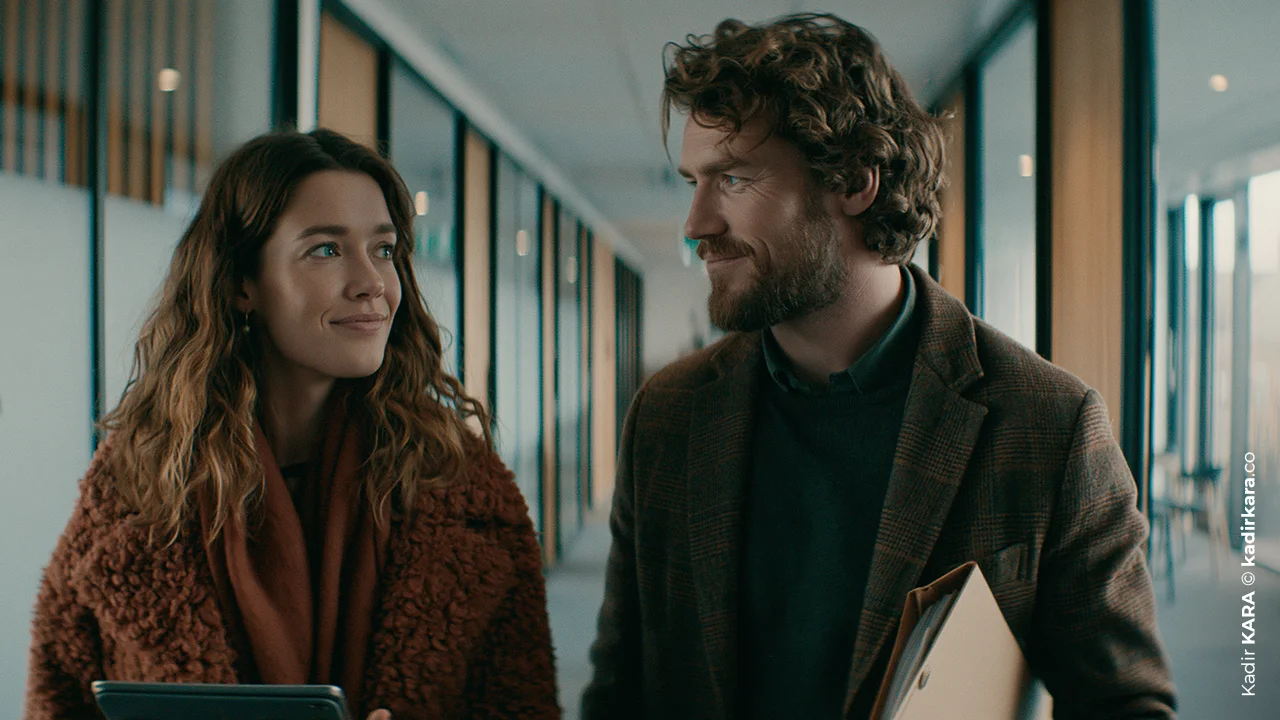
Eye Level: Neutral Ground
This is when the camera sits at the same height as the subject's eye level. It signals neither superiority nor weakness. It forms a natural and egalitarian connection, like eye contact in everyday life. This is why it's the default ground for dialogue scenes. Its true power lies hidden in its ordinariness: if Low Angle or High Angle feel this striking, it's because eye level is already coded as "normal" in the viewer's mind.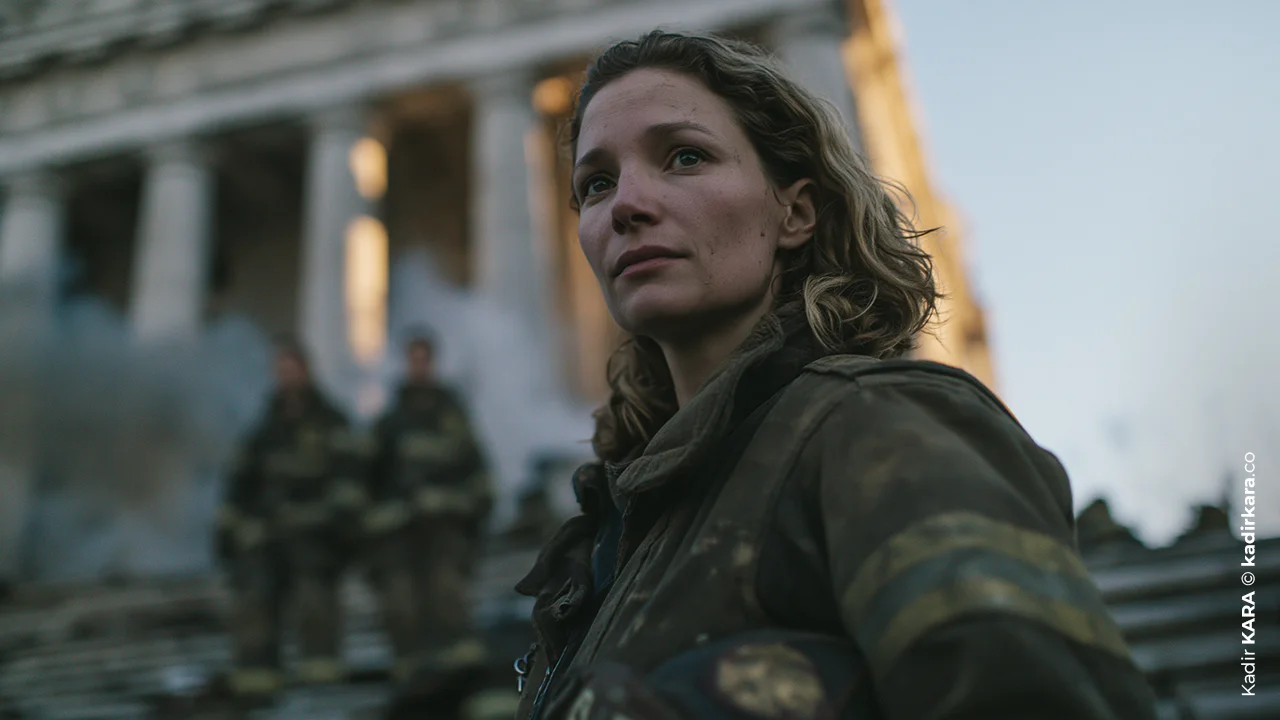
Low Angle: The Height of Power
This is when the camera sits below the subject's eye level and looks up. It makes the subject look bigger, stronger, more authoritative, and sometimes threatening than they actually are. In real life too, we always look up from below at things that dominate us; the camera borrows this instinct. It's frequently chosen in hero introductions and moments of triumph (like the scenes in The Matrix where Neo gains power).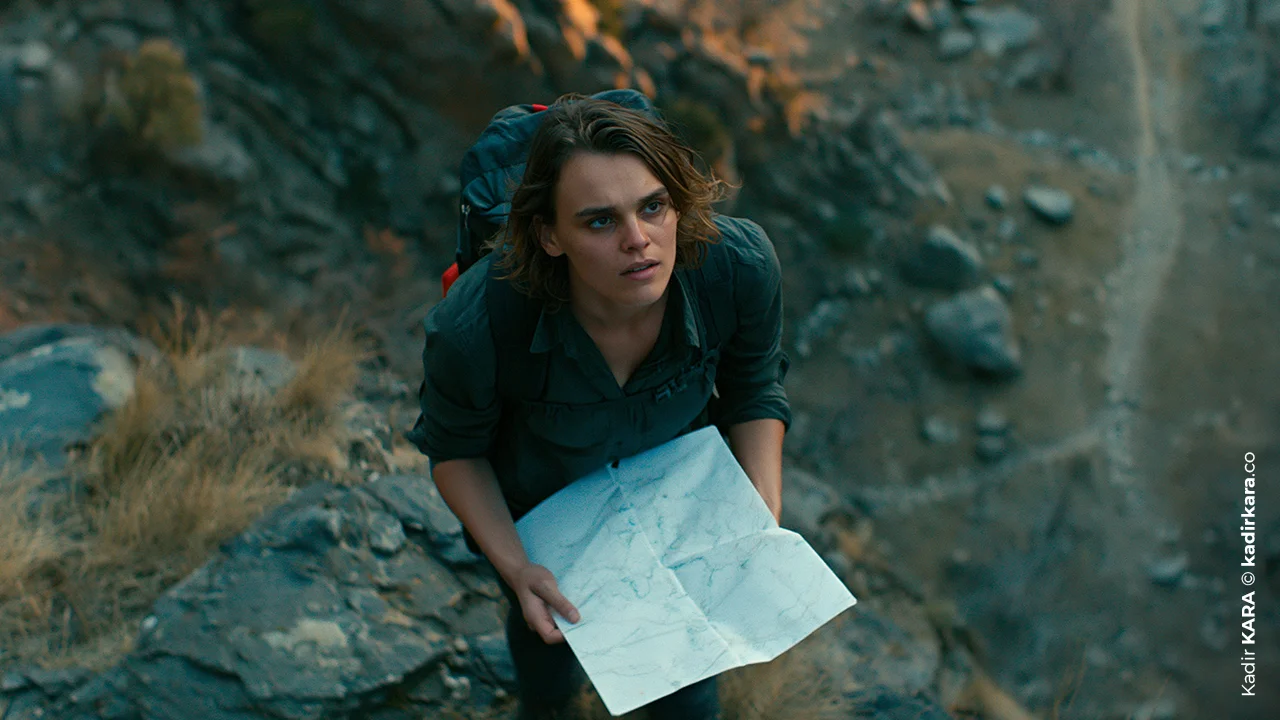
High Angle: The Diminishing Gaze
This is the exact opposite of Low Angle; the camera sits above the subject and looks down, making the subject look small and defenseless. The two angles are often paired within the same scene. As one is made to look powerful from below, the other is diminished from above, establishing the power balance in a single cut.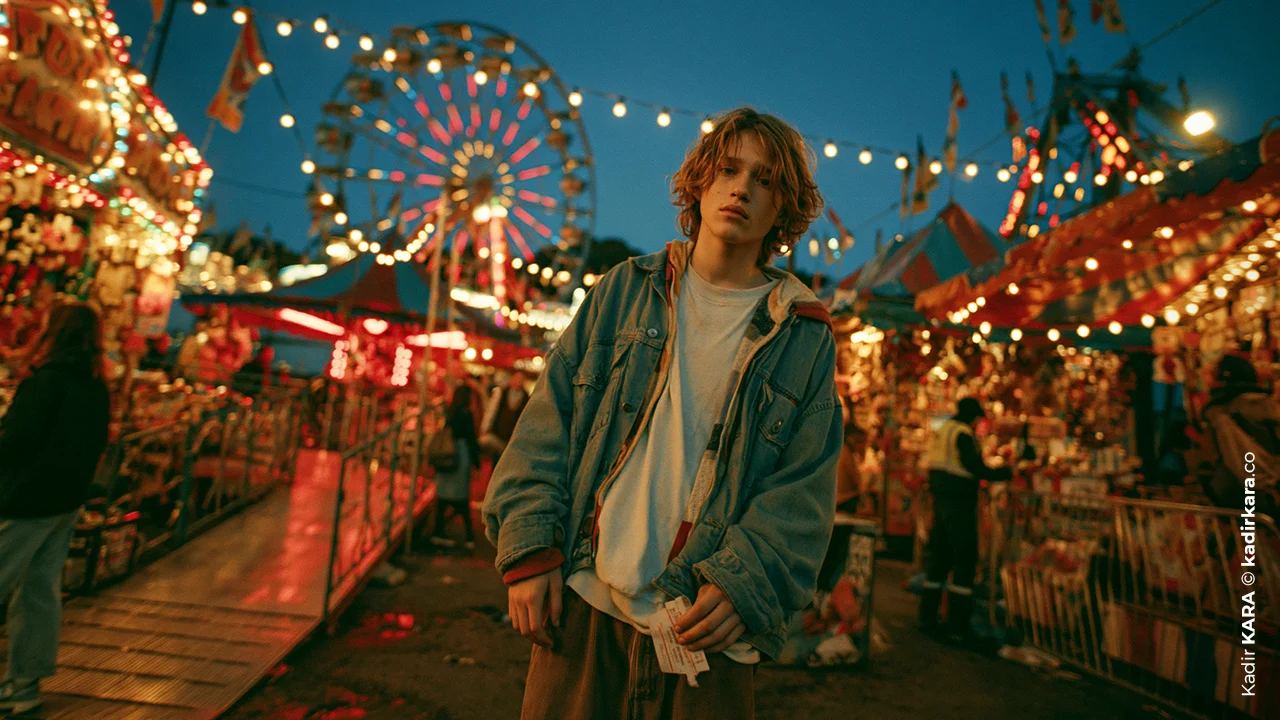
Dutch Angle / Dutch Tilt: The Moment the World Shakes
This is when the camera is tilted sideways so that the horizon line is not parallel to the bottom edge of the frame; it creates a feeling of instability, unease, and mental disconnection. An interesting detail: the name of this technique actually has nothing to do with Holland. This angle, which became widespread in 1920s German Expressionist cinema, may have entered English through the word "Deutsch" (German) gradually corrupting into "Dutch" over time. In other words, a translation accident probably wrote its name into film history this way. The textbook example of the technique is Carol Reed's 1949 film The Third Man; cinematographer Robert Krasker uses this angle frequently throughout the film to convey the feeling of alienation in post-war Vienna.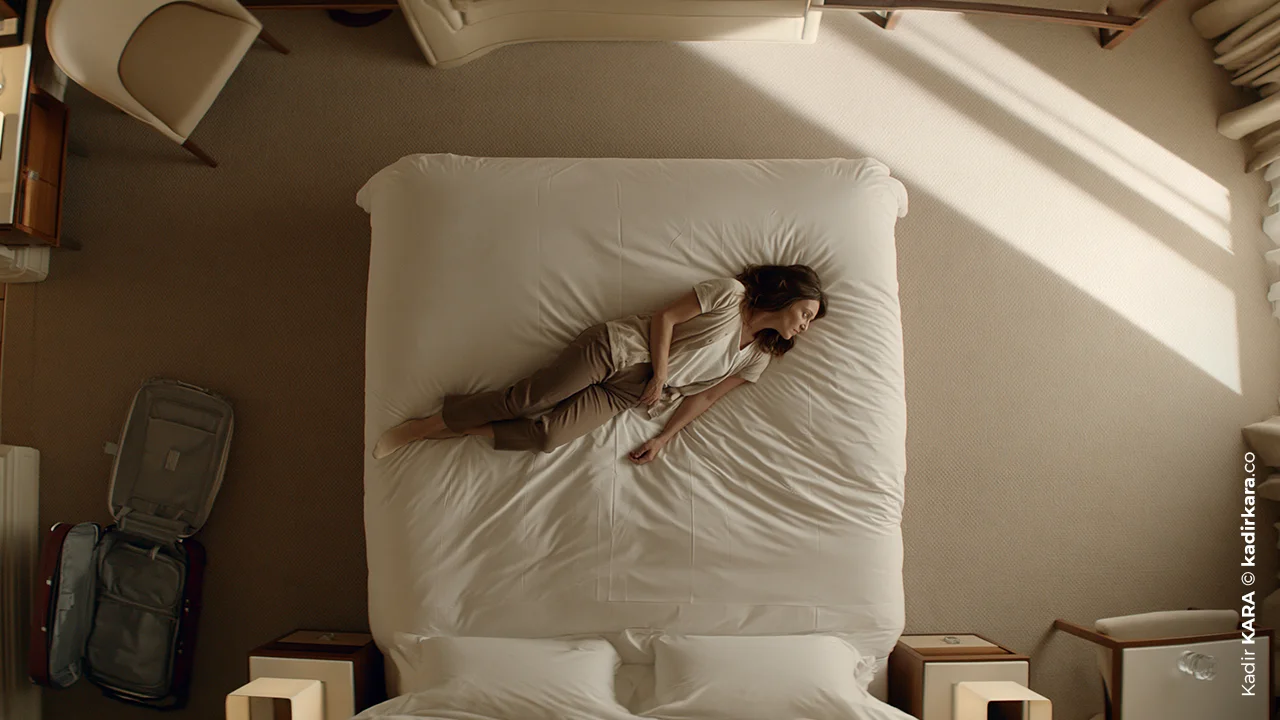
Bird's Eye View / Overhead Shot: Turning the Scene Into a Map
This is when the camera looks straight down from directly above the subject, at nearly a 90-degree angle. This position, one the human eye could never naturally see, takes the viewer outside the narrative and places them in an almost godlike observer's position. It presents the scene like a map, conveying choreography or a character's loneliness on a symbolic level.
Aerial Shot: Conveying the Vastness of a Place
This is a shot made from height using a helicopter or drone, covering a much wider geographic scale. The difference from bird's eye view is that the camera isn't positioned directly above the subject but at an angled perspective that also shows the horizon, covering a far broader area of geography; it's used in establishing shots to convey the vastness of a place.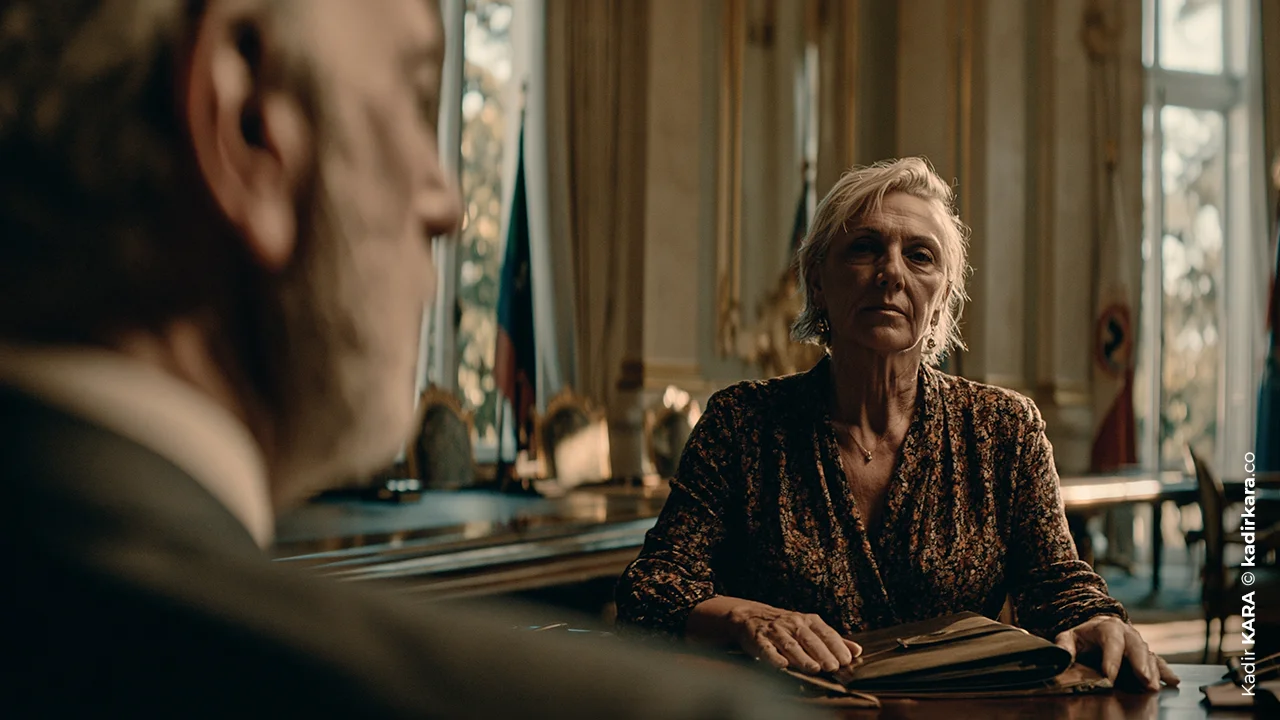
OTS (Over The Shoulder): Caught Between Two People
This is when the camera is positioned just behind one character's shoulder, framed to show the other character's face. In two-person dialogues, it clarifies the spatial connection and the interaction between them. Like in the opening scene of The Godfather, even without seeing the face of the character in front, we sense who holds the power.
POV (Point of View): Seeing Through the Character's Eyes
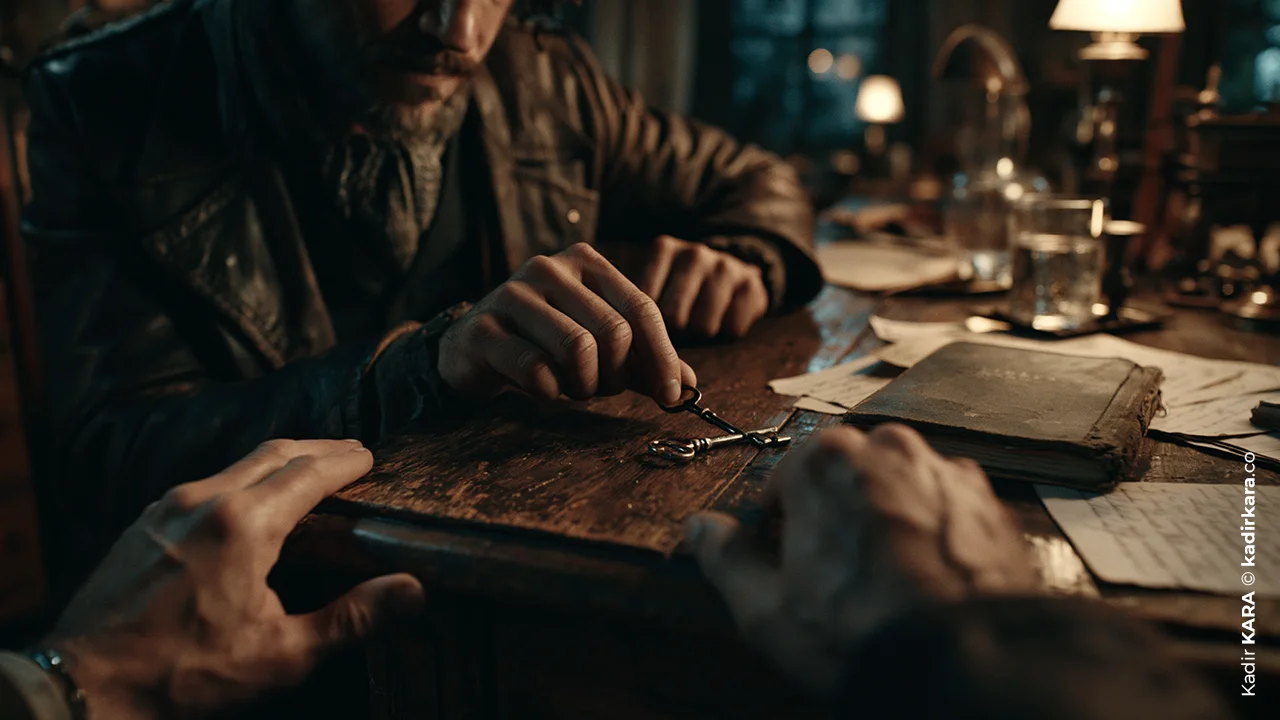
This is when the camera directly shows what a character sees. It carries the viewer to the point closest to the character's emotion. It directly triggers empathy, especially in horror and thriller. Like in the opening scene of Halloween (1978), the viewer experiences the event without knowing whose eyes they're looking through.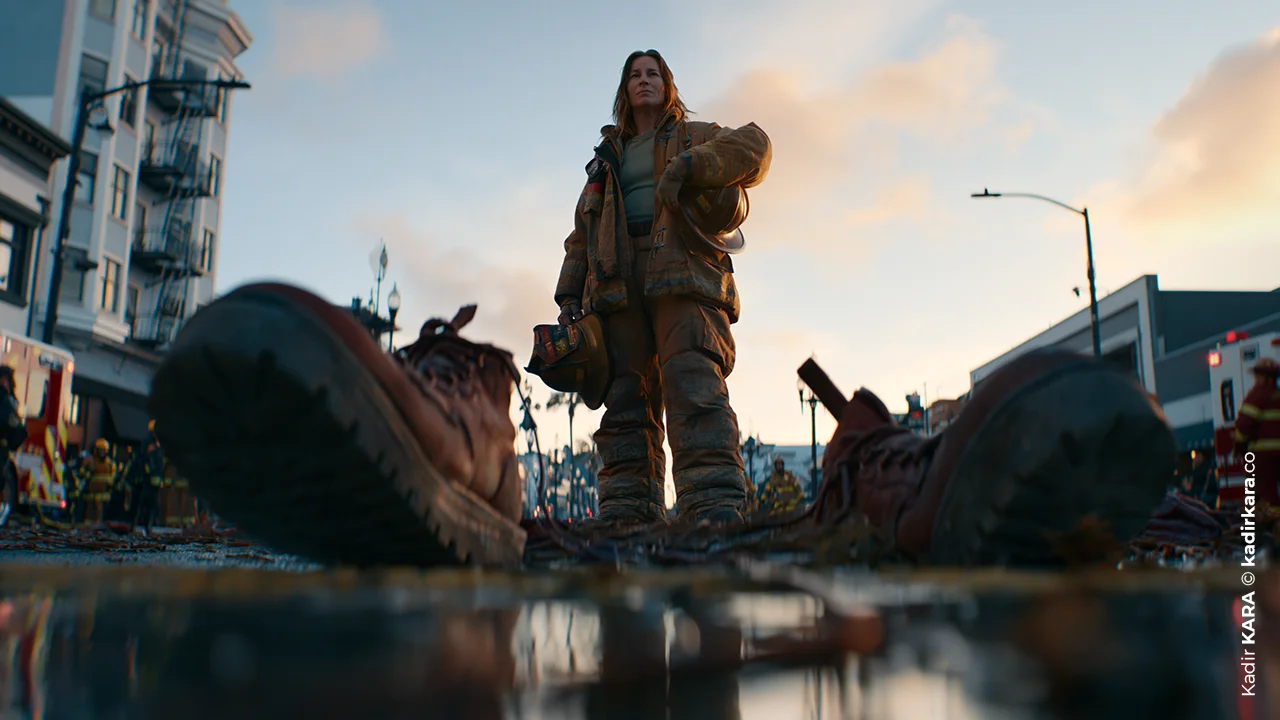
Worm's Eye View: Looking From the Ground to the Sky
This is the most extreme angle, where the camera lowers almost to touch the ground and looks directly upward. The difference from Low Angle is that it isn't merely below eye level, it's truly at ground level. This is why its effect is far sharper. While making the subject look massive, overwhelming, almost godlike, it evokes in the viewer the feeling of a child or an insect looking up at the world.
| ANGLE | CAMERA POSITION | PSYCHOLOGICAL AND NARRATIVE EFFECT | TYPICAL USE CASE |
|---|---|---|---|
| Eye Level | Same as the Subject's Eye Level |
Neutral, Equalizing, Realistic Connection | Dialogue Scenes |
| Low Angle | Below Eye Level, Looking Up |
Power, Authority, Heroism |
Hero/Powerful Character Introduction |
| High Angle | Above Eye Level, Looking Down |
Weakness, Helplessness, Smallness |
Defeat, Moments of Oppression |
| Dutch Angle | Horizon Line Not Parallel to the Frame | Instability, Unease |
Tension, Fear, Psychological Crisis |
| Bird's Eye View | Directly Above the Subject, ~90 Degrees | Map-like Feel, Isolation, Fate |
Choreography, Crowd Scenes |
| Aerial Shot | From Height, at an Angled Perspective |
Scale, Geographic Context |
Opening / Establishing Scenes |
| OTS (Over The Shoulder) | From Behind One Character's Shoulder | Spatial Connection, Mutual Interaction |
Two-Person Dialogues |
| POV (Point of View) | Shows Exactly What the Character Sees | Empathy, Direct Identification |
Fear, Action, Subjective Moments |
| Worm's Eye View | From the Ground, Looking Straight Up |
Overwhelming, Powerlessness, Childlike Wonder |
Emphasizing a Massive Structure or Character |
| A table showing the position, psychological effect, and use case of 9 camera angles. | Kadir KARA © kadirkara.co | ||
Which Angle Is Used in Which Scene? A Practical Guide
On a director's table, these decisions aren't made one by one — they're made together according to the needs of the scene. In a scene where a hero appears for the first time, Low Angle and a slight Tilt-Up combine. In a character's downfall, High Angle pairs with a slow Dolly-Out. In dialogue scenes, Eye Level and Over The Shoulder are the default language. As a scene grows tense, the camera moves closer without being noticed (Dolly-In). When introducing a location, Crane Shot or Aerial Shot come into play; in a character's mental unraveling, Dutch Angle or Roll take over.
NOTE: the camera is chosen after deciding what the viewer needs to feel, never the other way around. If technique comes first, it becomes showing off; if emotion comes first, it becomes a tool.
The 180-Degree Rule: Before Crossing the Invisible Line
There's a fundamental rule that's often overlooked when talking about camera movement and angle, yet governs both of them: the 180-degree rule. In a scene where two characters are talking to each other, an imaginary axis line is established, and the camera — regardless of which angle or movement is used for the shot — stays on only one side of this line. If the rule is broken and the camera crosses to the other side of the line, the characters' directions on screen suddenly reverse, and the viewer becomes spatially lost. While some directors deliberately break this rule to create intentional confusion, in most scenes this line is the silent condition for all the angle and movement decisions just described to work properly.
"The camera is an eye in the head of a poet."
Orson Welles
A SHORT NOTE
The reason I chose this topic is simple: this is the layer that briefs have skipped over the most for years. When a brand film or ad script comes to the table, everyone argues about "what will be told," while "how it will be shot" is mostly left to the director. Yet the question of where the camera is placed and how it moves is, in fact, the narrative itself. Over the years I've seen that when an art director or creative director sits at the table without knowing this language, they lose their strongest bargaining chip from the very start; the difference between saying "make it feel a bit stronger" and saying "we're dropping to a low angle, with a slight tilt-up" is exactly the difference between an amateur and a professional. I've covered this topic in detail because I think being able to speak this language will be useful not only to directors, but to everyone who writes briefs, requests revisions, and builds campaigns.
Communicating well with people, motivating the team, managing the process... all of these are necessary, but not enough on their own. A creative who doesn't know this language can't evaluate the director's or cinematographer's suggestions on set or in a production meeting; they can only approve or reject, they can't propose. Someone who genuinely knows these terms, on the other hand, sits at the table not just as someone who "wants" but as someone who "produces." There, beyond communication and organizational ability, real craft knowledge also becomes visible. The team senses this difference immediately; a good team shows someone who speaks the same language as them a respect that goes far beyond communication skill. That person is no longer seen as someone who just manages the process, but as someone who has a say in the process — almost regarded as having director-level status.
DID YOU KNOW? - 10 QUESTIONS 10 ANSWERS
1. Is Zoom really counted as a "Camera Movement"?
No, the camera doesn't physically move from its spot; only the lens's focal length changes. That's why many sources classify zoom as an "optical effect," separate from true camera movements like dolly.
2. What exactly is the difference between Dolly and Truck?
Dolly is the camera's movement toward or away from the subject (forward-backward). Truck, on the other hand, is a sideways (side-to-side) shift parallel to the subject. Both can be done on rails, but their directions are completely different from each other.
3. Why does Low Angle feel so powerful?
In real life, looking up at something from below generally means that thing is bigger than us or dominates us; the camera imitates this everyday experience to trigger the same feelings.
4. Can camera angle and movement change at the same time in a scene?
Yes, in fact, this is often the case. For example, the camera can start from a low angle and slowly tilt up while simultaneously dollying backward; these combinations can carry more than one layer of emotion within a single shot.
5. Are Bird's Eye View and Aerial Shot the same thing?
Not exactly. Bird's eye view looks down from almost directly above the subject, at a steep angle; aerial shot, on the other hand, is a height shot that covers a wider geography and is generally at a less steep angle.
6. What's the difference between Steadicam and gimbal?
Steadicam is a mechanical vest-and-arm system attached to the operator's body. Gimbal, on the other hand, is a more modern, motorized, electronically stabilized rig. Both aim for similar fluidity, but they work with different equipment logic.
7. Are Pedestal and Tilt confused with each other?
They're often confused. In Tilt, the camera stays in place; only its angle changes. In Pedestal, on the other hand, the camera itself rises or lowers vertically while its angle stays fixed.
8. When is Whip Pan chosen?
It's generally used when wanting to quickly show the passage of time, cover a long distance in a dramatic or comedic way, or create an energetic connection between two characters without cutting.
9. Where does the "American Shot" or "Cowboy Shot" get its name from?
It takes its name from the medium shot that cuts just above the knee, frequently used in western films to fit the cowboys' waist-level gun holsters into the frame.
10. Where does the word "Cinematography" come from?
It derives from the combination of the Ancient Greek words "kinema" (movement) and "graphein" (to write). Even in the word's origin lies hidden the idea that camera movement is itself a form of "writing."


