
In the spring of 2023, a job listing was looking for a "Prompt Engineer" - someone with no coding knowledge - for a salary exceeding 300 thousand dollars. Two years later, the same title had begun quietly disappearing from job postings. This was one of the fastest-rising and fastest-fading professions in the history of technology. This is not a profession that has vanished; it has become a skill everyone needs to have. Prompt engineering still exists today; it continues, not as a title, but as a reflex. In this article, we'll talk about both this strange rise-and-fall story and the concrete techniques that separate a good prompt from a bad one.
What Is a Prompt, What Is Prompt Engineering?
A prompt is the input text you give to an AI model. A question, an instruction, a task definition. Everything the model produces is, in fact, an interpretation of what you told it. Prompt engineering, on the other hand, is the process of designing, testing, and improving this input consciously rather than randomly.
The word "engineering" here is not a coincidence. The goal is to take trial and error out of being a one-off game of chance and turn it into a measurable, repeatable discipline. A well-constructed prompt actually resembles a small job description: role, context, constraints, format, and success criteria. All in a single text.
A poorly constructed prompt, on the other hand, asks the model for "something," without the person themselves fully knowing what they want; the result comes out just as vague. Because if certain criteria are required for an output to come out right, and you don't describe the rules for those criteria, the model fills the gap on its own: it treats everything unspecified as an assumption, processes it according to that assumption, and gives you the most "average" result. This is a result produced not for your job, but for everyone's job.
Let's look at this with a concrete example. When you say "create 10 tags for me" for a blog post, since the model has no criteria in hand, it puts together the most generic, most superficial words on the topic, because that's the only thing it can do. But when you elaborate on the same request as "give me 10 tags, make them SEO-compliant, optimize them for the 2026 search algorithm, diversify them according to different search intents," you get a completely different list in front of you. The task is the same, the topic is the same, but one is produced by assumption, while the other gives you the output by sticking to rules.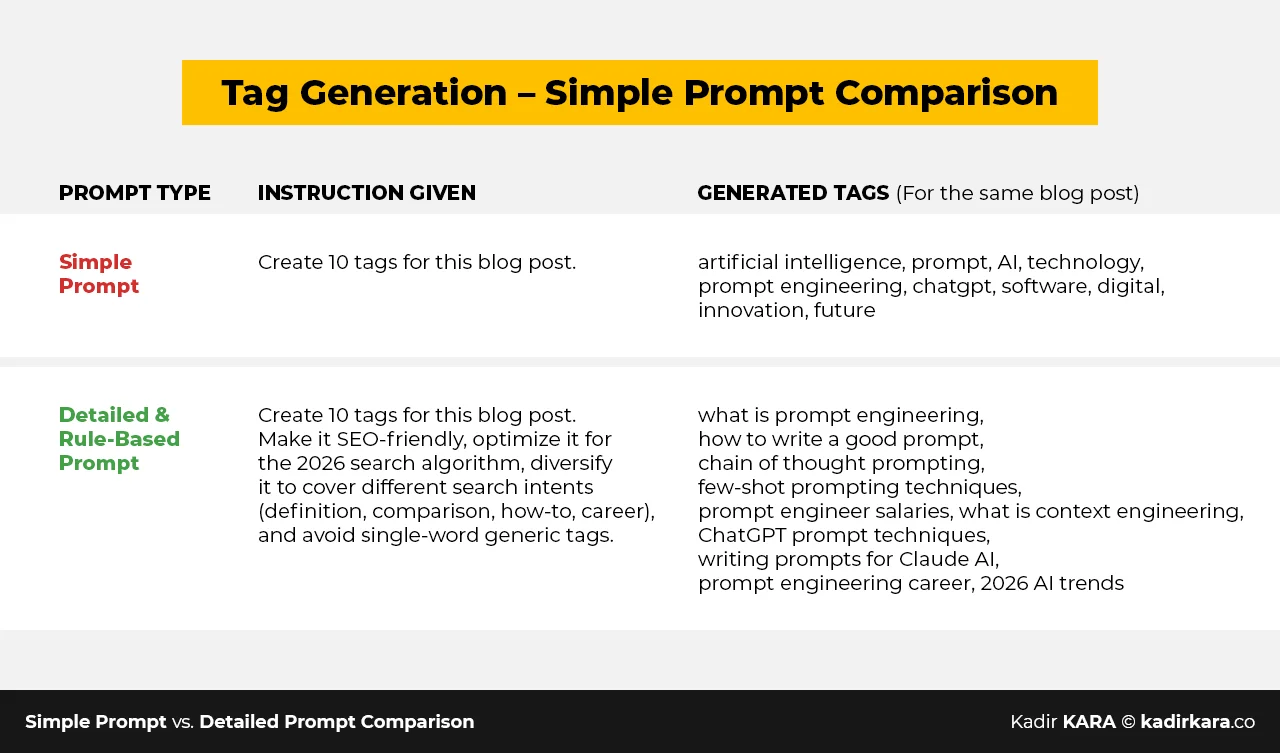
I simplify this as follows: Prompt engineering is actually the adaptation, for AI, of something we already know from human communication. Just as a clear brief produces better work, a clear prompt produces better output. The difference is that your counterpart is now a language model, not a teammate.
From 2023 to Today: The Birth, Peak, and Erosion of a Profession
The ChatGPT Explosion and the Age of the "AI Whisperer"
With ChatGPT's public release at the end of 2022, millions of people began talking directly with a large language model in everyday language for the first time. These models were still quite fragile at the time: they could give strange, inconsistent, or superficial responses to an ambiguous instruction. Getting the right result depended on being able to ask the right question in the right way, and this suddenly became a valuable skill.
The numbers also confirm this explosion: according to Indeed's search data, searches for the "prompt engineer" title in the US were 2 per million of total searches in January 2023, and by April 2023 they had jumped to 144 per million. In August 2023, in Gartner's Hype Cycle report — closely followed in the corporate world — prompt engineering was placed near the "peak of inflated expectations." The term was now being discussed not just in technical forums, but in boardroom meetings.
Salaries also reflected this excitement. The "Prompt Engineer and Librarian" position, published by Anthropic in the spring of 2023 and which became one of the symbolic listings of the era, offered a base salary between 175,000 and 335,000 dollars. And this without even requiring coding. The press quickly labeled these roles "AI whisperer."
Why Did Models "Swallow" Prompt Engineering?
The unpredictable decline that followed this rise was actually based on a logical reason. Models rapidly got better. GPT-4 and the generations that followed it, unlike previous models, could reasonably interpret ambiguous, disorganized instructions written in everyday language. The "magic formulas" that once had to be carefully constructed became details that the model itself could now compensate for.
In parallel with this, companies chose to teach prompt writing to all their employees instead of leaving it to a single specialist. In a study Microsoft conducted with 31,000 employees across 31 countries, companies were asked which new roles they would prioritize in the next 12-18 months; "Prompt Engineer" landed near the bottom of the list, in second-to-last place. OpenAI's announcement of its free "OpenAI Academy" training platform sent the same message: this was no longer a field requiring expertise, but had become basic literacy.
An interesting technical development accompanied this process as well. AI can now write its own prompts. In the "Automatic Prompt Engineer" approach, a model generates candidate prompts, these are tested on the target model, and the one with the best performance is selected — without a human hand ever touching it... This job, which once required special expertise and experience, ironically automated itself. The task of the person hired to write prompts is now being taken over by a model that writes its own prompt.
What happened by 2026? Did the profession die, or did it evolve?
Today, "Prompt Engineer" as an independent job title is no longer sought after in most companies working with frontier models. But it would be wrong to read this as "the skill has disappeared." Because the opposite happened. The skill turned into a standard component of broader roles such as AI Engineer, LLM Engineer, and AI Product Manager. Total compensation in these roles hasn't shrunk either; writing prompts is no longer a line in the job description, but a prerequisite.
Wikipedia's entry on the subject also clearly summarizes this transformation: as a title, it lost momentum, but as a skill, it continues to gain increasing importance in research and professional contexts.
To put it simply: in a world where everyone is a "prompt engineer," there was no longer a need for a separate title.
The Anatomy of a Good Prompt: Practical Techniques
The title may have disappeared, but the techniques haven't. On the contrary, they have become a basic repertoire that everyone now needs to know. Here are the elements that really make a difference when building a prompt.
Clarity and Context
The model's greatest enemy is ambiguity. The difference between "write me a text" and "write a 500-word blog introduction for designers, in a tone that is warm but authoritative" is directly visible in the quality of the output. Clearly stating the task, the target audience, and the purpose; telling the model not just what you want but also why you want it, greatly increases the accuracy of the output.
Assigning a Role and Persona (Role Prompting)
Giving the model a specific expert identity, such as "You are an experienced...," shapes the framework, tone, and perspective of the output. This technique works especially well in tasks where tone and domain knowledge need to stand out; the model activates the implicit norms carried by that role (register, priorities, mode of address).
Exemplification: Zero-Shot, Few-Shot, and Chain-of-Thought
Giving the model direct instructions without any examples is called zero-shot prompting; it's sufficient for simple, well-defined tasks. Providing a few concrete examples along with the instruction is called few-shot prompting. If format or tone consistency is critical, this technique makes a big difference. For complex tasks that require multi-step reasoning, chain-of-thought comes into play: asking the model to think step by step before giving the result, instead of giving it directly, notably increases accuracy, especially on logical and multi-component questions.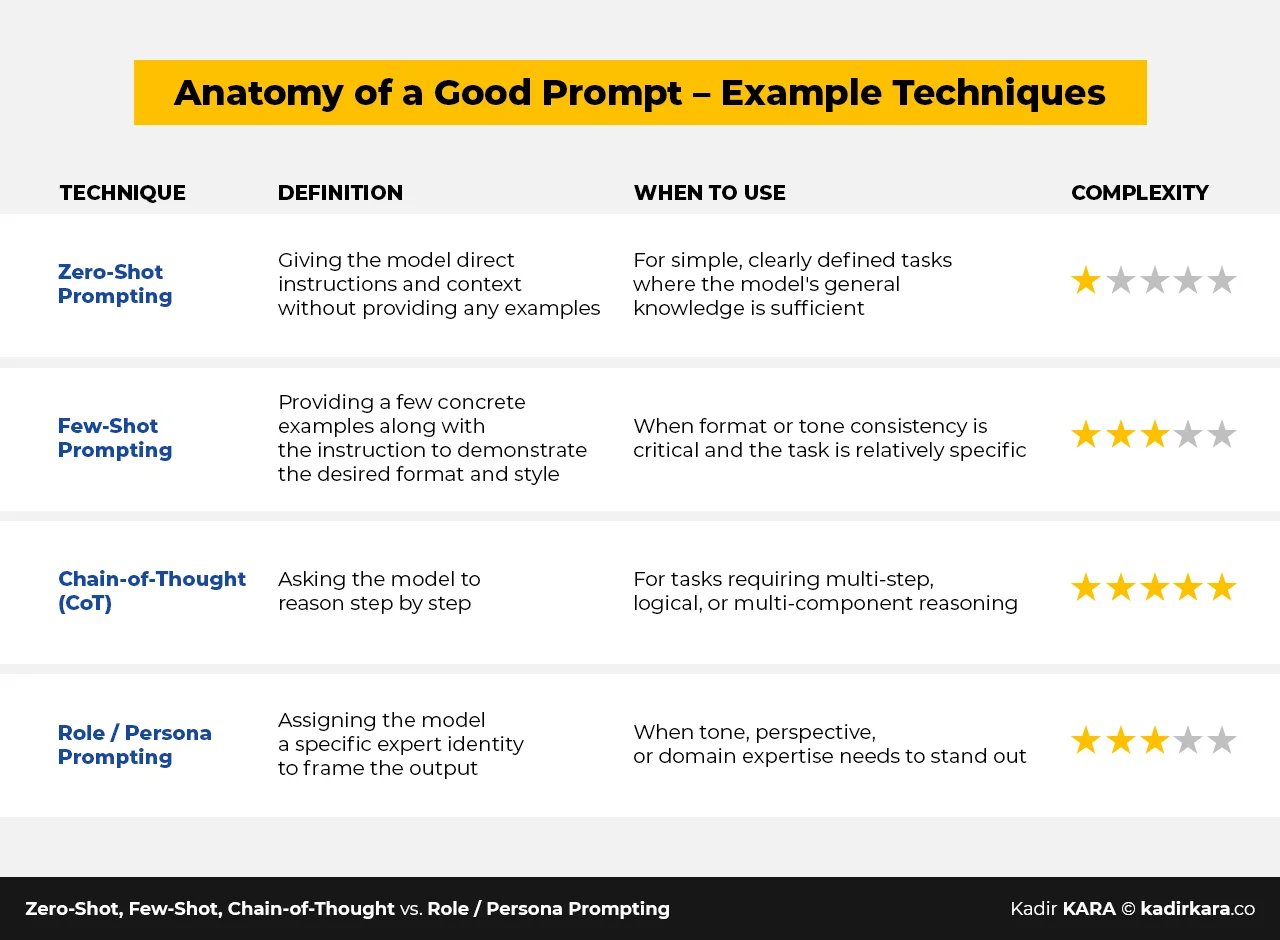
Clearly Defining the Output Format
Clearly stating what you expect from the model - definitions like length, structure, whether it should be bulleted or plain text, a table or a paragraph - greatly reduces the number of revision rounds needed afterward. If the format is ambiguous, the model brings its own assumption into play, and this is usually something different from what you wanted.
Clarifying Structure with Delimiters
In long or multi-component prompts, separating instructions, examples, and context from one another clarifies things for the model. Anthropic's own documentation is clear on this point: prompts structured with XML-like tags (marking sections such as instruction, example, and context separately) help the model understand more accurately what each piece of text is for, especially in long and multi-part tasks.
A Prompt Doesn't Become Perfect in One Go
Perhaps the most overlooked fact is this: a good prompt usually doesn't emerge on the first try. A draft is written, the result is observed, where the error came from is understood (an ambiguous instruction? missing context? a wrong assumption?), and it's revised accordingly. Writing a prompt is not a one-time act of giving a command, but a craft that's continuously improved. Just like a design going through rounds of revision.
When I write a prompt that I'll use regularly, I run this process exactly this way. First, I do the necessary research and place the rules that will raise the output quality to the highest level into the prompt from the start. But the real test comes after I start using the prompt; after the first three or four outputs, thanks to the concrete results in front of me, I can clearly see what's still missing, and I update the prompt by focusing exactly on those points. Instead of trying to write it perfectly from the start, I move forward by closing the gaps the output shows me, and by the end of the day I end up with a prompt that produces the output I want in the best possible way.
Is Prompt Engineering Enough on Its Own?
Prompt engineering is the most accessible tool, but it's not the only one. If a model's behavior needs to be permanently changed, fine-tuning comes into play; if the model needs current or organization-specific knowledge, RAG (retrieval-augmented generation) is used. In recent years, a new one has been added to these: Context Engineering. This goes beyond optimizing a single prompt text and covers managing everything the model "sees" at that moment (past messages, tools, files, system instructions) as a whole. This distinction is becoming increasingly critical, especially in long-running, multi-step AI agents.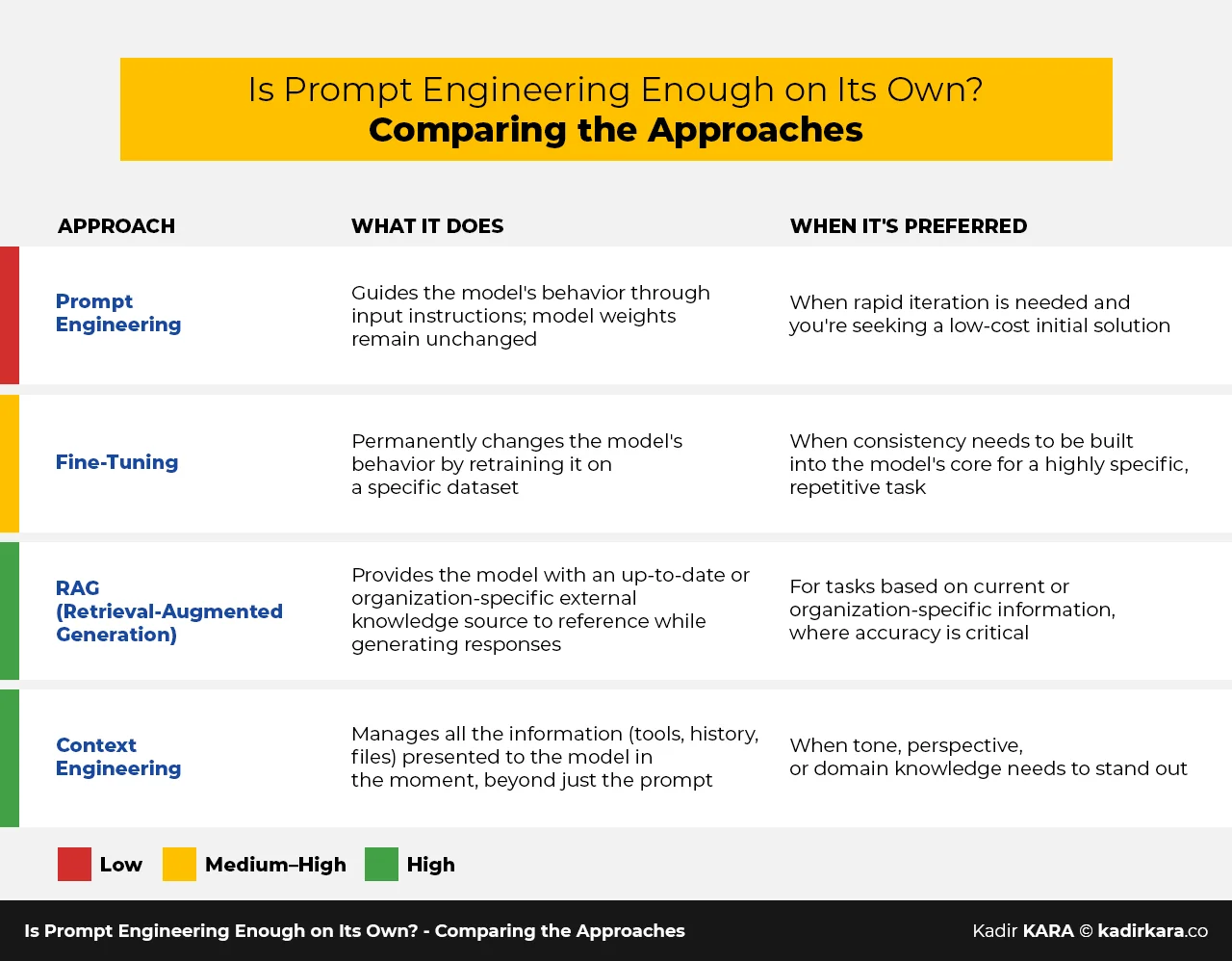
Why Prompt Engineering Is an Art Direction Skill for Creative Professionals Here
I want to say something to designers, art directors, and visual creators. This skill should not feel foreign to you at all. Writing a prompt is actually not that different from writing a brief. Describing the goal, giving references, setting boundaries, saying which detail takes priority... You're now doing the exact same direction to a model that you've been doing to a photographer, a director, a junior designer for years; the counterpart has changed, but the logic hasn't.
That's why, instead of seeing prompt engineering as a "new and strange technical skill," I recommend seeing it as a new application area of an ability you already have (the ability to give clear and accurate instructions). For every creative professional working in AI visual generation, video production, or copywriting, this is now an important part of a toolkit as fundamental as Photoshop or Premiere.
A SHORT NOTE
The reason I chose this topic is simple; lately, a significant part of my workflow now runs through writing prompts, both for my own blog visuals and for client work. In my 18-year career, writing a brief, giving direction on set, leaving clear notes in post-production were always the same thing... Explaining to the person in front of me what I wanted with as little ambiguity as possible. Prompt engineering never felt foreign to me because I had already been doing this with people for years (even if they sometimes didn't understand what I was explaining (: ); now I'm doing it with models.
I also have a word of caution on this; don't see prompt engineering as some magic formula. Even the best prompt cannot replace a clear vision. First clarify in your own mind what you want, then explain it to the model. That's the order, not the other way around. No matter how well you choose your words, if you don't have a clear output or image in your mind, the model will give you something blurry too.
DID YOU KNOW? - 8 QUESTIONS 8 ANSWERS
1. In 2023, were salaries really being offered reaching 300 thousand dollars for the title of "Prompt Engineer"?
Yes. The "Prompt Engineer and Librarian" listing published by Anthropic in the spring of 2023 offered a base salary between 175,000 and 335,000 dollars, without requiring coding. In the press of the time, this listing became the symbol of the "AI whisperer" label.
2. How fast did searches for "Prompt Engineer" increase, and what happened after that?
According to Indeed data, US searches for this title were 2 per million in January 2023, and jumped to 144 per million by April 2023. They then declined rapidly and settled at a level of around 20-30 per million.
3. Why did the term get "diluted" so quickly?
In linguistics, this is called Semantic Diffusion: as a highly technical term reaches wider audiences, it becomes simplified and loses its original sharpness. Cloud, Big Data, and Blockchain are among the terms that have gone through the same process.
4. Can one AI write a prompt for another AI?
Yes, this is called "Automatic Prompt Engineering." A model generates candidate prompts, these are tested on the target model, and the one with the best performance is selected. I also constantly do a manual version of this myself; while working on a prompt in Claude, I can ask Gemini for a different perspective, get suggestions that broaden my view, and add them to the prompt. Or I can write all my rules and requests, take the final prompt I got from Claude to ChatGPT, and ask which rules are missing from that prompt. I don't do this for every prompt, of course. (: How far I go depends on how critical and long-lasting that prompt will be for my work. If it's an output I'll be using for a long time and one that really matters to me, I never skip getting cross-perspectives from different AI tools.
5. Is "Context Engineering" different from prompt engineering?
Yes, and it's a distinction that's being talked about more and more. While Prompt Engineering optimizes a single instruction text, context engineering covers managing all the information the model sees at that moment (past messages, tools, files, system instructions) as a whole.
You can think of it this way: when you tell a model, one time, "edit this text," the only thing you need is a well-constructed prompt; the task happens and the matter is closed. But if that same model is working with you on a multi-step task that lasts for hours (it needs to have read dozens of files, needs to remember previous decisions, needs to know which question has already been resolved), a single prompt is no longer enough. At every step, you need to decide which information is still useful and which has become unnecessary overhead. Context Engineering comes in exactly here: which part of the past conversation will be kept, which file will still remain open, which old information will now be treated as junk and cleaned out... While prompt engineering optimizes "what I'm saying," context engineering optimizes "what the model is actually seeing right now."
6. Does the "Chain-of-Thought" technique really work?
Yes, for tasks that require complex, multi-step reasoning. Asking the model to think step by step before giving the result, instead of giving it directly, notably increases accuracy, especially on logical questions.
7. Has the profession of prompt engineering really "died"?
As an independent job title, it has largely eroded, yes. But as a skill, it hasn't disappeared, on the contrary it has spread. Today, this ability has become a standard part of broader roles such as AI Engineer, AI Product Manager. You can think of it this way: literacy was once a quality specifically sought after and highlighted in job listings, because not everyone had it. Today, no listing writes "must know how to read and write," because this is now an unquestioned basic. Prompt engineering is following the same path: it has stopped being a separate title and turned into a basic prerequisite for being able to do the job.
8. What concrete technique do model developers recommend when writing prompts?
Anthropic's official documentation recommends separating instructions, examples, and context with XML-like tags, especially in long or multi-component prompts. This helps the model understand more clearly what each piece of text is for. When I write a prompt that I'll use regularly, I apply this exactly: depending on the content of the topic, I first divide everything into separate categories, then under each category I write out, one by one, all the rules that need to be followed in that section. The model sees the text in front of it not as fragmented pieces, but as a structure where it's clear from the start what each section is for, and the output turns out to be much more accurate as a result.


